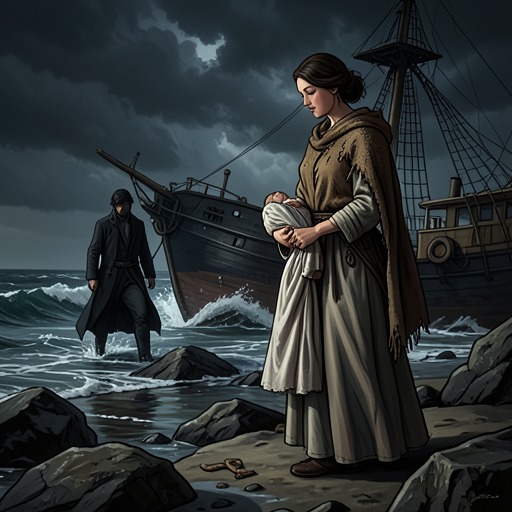
Beritola Caracciola
The DecameronBeritola Caracciola is a Neapolitan noblewoman whose story turns political defeat into profound personal dispossession, then makes maternal recognition the hinge of a hard-won reversal. Separated from her husband and both sons, she is stranded on Ponza, where she lives in isolation with a wild goat and its kids; later, in Lunigiana, she encounters her surviving son without knowing him until memory of his childhood features breaks through. Her tale makes the injuries of Fortune intimate: a kingdom changes hands, a family is scattered, and reunion depends on identities hidden and recognized.
Identity and Political Ruin
Beritola is the wife of Arrighetto Capece, a Neapolitan gentleman who held the governance of Sicily under Manfred, its king. After Charles I of Anjou defeated and killed Manfred at Benevento, the island revolted to the victor. Arrighetto, unwilling to become the subject of his lord’s enemy and doubtful of the Sicilians’ loyalty, prepared to flee. His plan became known, however, and he and other adherents of Manfred were seized and delivered to Charles along with possession of the island.
The political reversal leaves Beritola without reliable news of her husband and afraid of what may befall her. Poor and pregnant, she abandons her possessions and escapes by boat with her young son Giusfredi. At Lipari she gives birth to another son, Scacciato, and, after obtaining a nurse, sets out by ship for Naples to seek her relatives. The voyage does not take her where she intends: contrary winds carry the ship to Ponza, where she and her companions wait for a chance to continue.
Loss and Solitary Survival on Ponza
On Ponza, Beritola goes to a remote place to mourn. Her daily lament becomes the occasion for a second catastrophe: while she is away, pirates seize the nurse and both children, along with the little ship, and tow them out to sea. Returning to the shore, Beritola sees the galley at a distance and understands that she has lost her sons as well as her husband. She collapses on the strand, then searches the caves in vain before returning to the place where she has been accustomed to weep.
Hunger and grief shape her existence on the island. After a night without food, she browses on herbs. She then sees a she-goat enter a nearby cave and, finding two newborn kids inside, takes them to her breast. Her milk has not yet dried after giving birth; the kids suckle, and thereafter make no distinction between her and their dam. The scene gives her isolation a striking form of care: with her own children gone, she nurses the young animals and makes a life among them.
From the Island to Lunigiana
A hunting party led by Currado Malespina comes upon Beritola after his dogs pursue her. By then she has grown lean, dark, and hairy. Currado and his wife are astonished by her appearance, as she is by theirs. At her request Currado calls off the dogs, and, after much entreaty, she tells them who she is and what has happened. She also makes clear that she has resolved to remain alone on the island.
Currado, who knew Arrighetto, weeps for her misfortune and offers either to take her home or to maintain her in his household with the honour due a sister. Beritola will not go where she might be recognized. Currado’s wife nevertheless persuades her to accompany them to Lunigiana, bringing the two kids and their mother, the she-goat. Because Beritola’s name is unknown there and she travels with the goat, she comes to be called Cavriuola. At Currado’s castle she lives in widow’s clothing as a waiting-woman to his wife, modest and obedient, while continuing to care for the kids.
Her Sons’ Hidden Identity and the Reunion
The pirate galley carries the nurse and both boys to Genoa. They become the property of Messer Guasparrino d’Oria and are sent to serve as slaves in his household. The nurse fears that the boys could be endangered if their birth were discovered, so she conceals their identities and tells people they are her sons. She renames Giusfredi Giannotto di Procida, repeatedly explaining the danger and instructing him to keep the secret; he obeys her. The children’s separation from Beritola is thus accompanied by a deliberate concealment intended to preserve their chance of recovering their former station.
The recognition in Lunigiana comes only after Beritola’s son has returned to Currado’s household and married Spina, Currado’s daughter. Currado asks Giannotto whether he would be glad to see his mother, if she were still alive. Beritola hears the exchange and, prompted by the boyish features she remembers, rushes to embrace him before anyone can explain. Emotion overwhelms her and she falls into his arms as if dead. Though astonished that he has seen her in the castle before without recognizing her, Giannotto knows her by what the story calls her maternal odour. He weeps, receives her, and kisses her tenderly. When Beritola regains her senses, she embraces him again; mother and son exchange the account of what has befallen them, while Currado’s wife and Spina tend them.
Fortune, Kinship, and the Ending
The reunion restores what Beritola’s solitary life could not: the possibility of kinship, marriage alliances, and renewed standing. Currado announces the new alliance formed by Giannotto’s marriage to Spina and orders a splendid entertainment. The story’s heading also records that Sicily rebels against Charles, Beritola’s other son is found, and the family is restored to high estate. The supplied account does not detail the circumstances of that second recovery, but it completes the movement from scattering toward restoration.
Beritola’s experience is framed as one of Fortune’s grievous reversals, first described to the company as a pitiful story whose bitterness seems scarcely assuaged by its joyful ending. Her survival is not a simple triumph over loss: she endures the disappearance of her husband and children, the stripping away of her possessions, and the long obscurity of her life as Cavriuola. Yet the story gives maternal memory a decisive role in reversal. The son’s concealed name has protected him, while the remembered lineaments of his childhood allow his mother to know him. Her passage from isolated nurse of the kids to mother welcomed into a recovered family makes reunion, rather than worldly security alone, the emotional measure of restored fortune.